About Melrose

Melrose, a post town and burgh of barony, in the southern section of the parish just described, between the Tweed and the northern base of the Eildon Hills. The station, on the Waverley section of the North British railway system, is 3¾ miles ESE of Galashiels, 15½ N by E of Hawick, and 37¼ SE by S of Edinburgh. By road, the place is 7 miles NE by N of Selkirk, 11 NW of Jedburgh, and 35 SE by S of Edinburgh. The situation and surroundings are very beautiful. Looked at from about the town, the heights that border the Tweed seem to close in at either end, so that the place nestles in the long hill girt hollow known as the Vale of Melrose. The town, which dates from very ancient times,was originally a small village called Fordel, and the present name
was transferred to it from Old Melrose at or shortly after the foundation of the abbey in 1136. It shared largely and constantly in the fortunes of the monks. During Hertford's invasion, in 1544- 45, it was twice plundered and destroyed; and though, after the Reformation it struggled on for a time as the seat of a small trade, it ultimately fell into poverty and decay, a state of matters that lasted well into the present century. Then the revival of the taste for Gothic architecture brought the ruins of the abbey into prominence, and this, and the associations of the district with Sir Walter Scott, made it a tourist centre. The tourists were followed by people of independent means, who were led by the beauty and amenity of the neighbourhood to take up here their occasional or permanent residence, and all these causes combined have given Melrose a fresh start in prosperity. The town proper, which is the Kennaquhair of the Abbot and the Monastery, consists of 3 streets, branching off from the corners of an open triangular space, known.
As the market place, close to the station. The street leading northward to Gattonside, and that passing southward by Dingleton, are both narrow and old, but High Street, which leadsnorth-westwards towards Galashiels, has been widened and improved as new buildings have replaced old. The suburbs are
principally lines and groups of villas, extending about a mile westward from the end of High Street, by Weirhill and High Cross. Many of the older houses of the town show, amid the general plainness of their walls, stones whose carvings prove that they have come from the ruins of the abbey, at a time when its walls were deemed of so little importance as to be practically a quarry for whosoever chose. In the centre of the market place, supported by five courses of steps, stands the market cross, bearing the date of 1642, and surmounted by the unicorn of the Scottish arms with mallet and rose. It seems to have replaced an older cross of some sanctity, which was destroyed in 1604. A patch of land, called 'the Corse Rig,' in a field near the town, is held by the proprietor on the condition of his keeping the cross in repair. Another cross, which anciently stood on a spot about ½ mile to the W, bore the name of the High Cross, which it has bequeathed to the modern suburb around its site. The so-called jail has long ceased to be used for that purpose, and the lower part is now a store for the victual feu-duties payable by the Duke of Buccleugh's vassals, while the upper is occasionally used as a public hall. It stands on the site of an older jail, on a stone of which, that is still preserved, there is sculptured one of those anagrams that were from two to three centuries ago somewhat common, viz.:-a mason's 'mell' and a 'rose,' representing the name of the place. In an old gabled house, bearing the date of 1635, which projected into the street opposite the King's Arms Hotel, but which is now demolished, General Leslie slept on the night before the battle of Philiphaugh.
A suspension bridge (1826) for foot-passengers crosses the Tweed to the N of the town, and still in use today, behind and a little below the Weirhill, and connects Melrose with Gattonside. The parish church, a plain and indeed somewhat ugly building, with a spire and clock, was erected in 1810, and stands on a rising ground-the Weirhill proper, the Weir being behind it-in the Weirhill suburb. The Free church, which stands on the same eminence, is a handsome building in the Early English style, with a well proportioned spire, and containing 550 sittings. The U.P. and Congregational churches call for no special notice. The former, which was built at High Cross in 1872 to replace a small barn-like structure in the town, contains 500 sittings; the latter contains 250 sittings. Trinity Episcopal church, in the western part of Weirhill, was built in 1849 after designs by Sir George Gilbert Scott. It is a tasteful building in the Early English style, with a good eastern window and a stone pulpit. It contains 175 sittings. The cemetery is to the S of the Free church.
The Corn Exchange, in the market place, was erected in 1862-63, after designs by Cousin, at a cost of about £3000, and is a large handsome structure, serving not only for sales and similar purposes, but also for lectures, concerts, and public meetings. The hall has accommodation for 500 people. The public schools have been already noticed under the parish.
The waterworks belong to a joint-stock company (1838), and the water, which is very pure, is obtained from springs on the Eildon Hills. The reservoir has a capacity of about 35, 000 gallons. Gas is also supplied by a joint-stock company (1836); and the drainage system, which is by no means complete, and does not include the whole of the town, was carried out by voluntary assessment. There are now no industries, but the place was long famous for the manufacture of a fabric called Melrose-land linen, for which there was a demand in London as well as in foreign countries. So early as 1668 the weavers were incorporated under a seal-of cause from John, Earl of Haddington, the superior of the burgh, and for a considerable period preceding 1766 the quantity of linen stamped averaged annually between 23,000 and 24, 000 yards,valued at upwards of £2500. Towards the end of last century, however, the manufacture rapidly declined, and long ago became quite extinct. Cottonweaving for the manufacturers of Glasgow which followed had a short period of success, but soon also became extinct. A bleachfield for linen, which still gives name to a spot on the W slope of the Weir Hill, was also tried but failed, and even the woollen trade, so singularly prosperous in some of the other Border towns, though tried, proved also a failure. Melrose, under the abbey, was a burgh of regality; but in 1609, when the Abbey and lands were erected into a temporal lordship, it was made a burgh of barony, which status it still retains. There is a baron-bailie appointed by the present superior, the Duke of Buccleuch, but there are no burgh courts and no burgh property, income, or expenditure. An ancient fair, held in spring, called Kier or Scarce-Thursday fair, was long a famous carnival season; but afterwards became merely a business market, and then died out altogether. The weekly corn and general market is on Monday: fairs for hiring are held, for hinds on the first Monday of March, for young men and women on the first Monday of May and the first Monday of November, and for harvest hands on the first Monday of August; for cattle and horses on the first Wednesday of June and 22 Nov., unless that day fall on Saturday, Sunday, or Monday, and then on the Tuesday following; for lambs-the largest fair in the Border counties-on 12 Aug., unless that day be a Saturday, Sunday, or Monday, and then on the Tuesday following; and for ewes and other stock on the Saturday after the first Tuesday of October. These markets have now, however, almost disappeared, owing to the establishment of weekly cattle sales at
Newtown St Boswells.
The town has a head post office, with money order, savings' bank, insurance, and telegraph departments; branches of the British Linen Company and Royal banks, agencies of 15 insurance companies, and 6 hotels. A justice of peace court is held on the first Wednesday of every month, and sheriff small debt courts on the Saturdays after the second Monday of February and May, after the first Monday of September, and after the second Monday of December. Among the miscellaneous institutions are two boarding schools for young ladies, a masonic hall, a public library, bowling, curling, and cricket clubs, a company of rifle volunteers, a horticultural and floral society, a branch of the Bible Society, and a branch of the Society for the Prevention of Cruelty to Animals. The members of the masonic lodge (St John's-not, however, in connection with the Grand Lodge) have, every year, on St John's Eve, a torchlight procession round the abbey, and on Fastern's E'en a football match between the married and unmarried men of the town is kept up along the main street from early afternoon till evening. Pop. of town (1841) 893, (1861) 1141, (1871) 1405, (1881) 1550, of whom 913 were females. Houses (1881) 321 inhabited, 15 vacant, 7 building.
The Abbey of Melrose, which is the great centre of attraction in the town, stands on low level ground to the E, almost midway between the Eildons and the Tweed. Coming in succession to the Columban establishment already noticed, but moved to a better site, it was founded by David I. in 1136, the monks, who were of the Cistercian order, having been brought from Rievale in Yorkshire. To them, and 'to their successors, for a perpetual possession,' David granted 'the lands of Melros, and the whole land of Eldune, and the whole land of Dernwic. . . all the fruits, and pasture, and timber in my land, and in the forest of Selkirk and Traquhair, and between Gala and Leadir Water, besides both the fishery on the Tweed everywhere, on their side of the river as on mine, and.. in addition, the whole land and pasture of Galtuneside.'The original buildings were not finished till 1146, in which year, on 28 July, the church was, with great solemnity, consecrated and dedicated to the Virgin Mary. Malcolm IV. confirmed the grants of his predecessor, and added fresh lands, as also did William the Lyon, in whose reign the monastic possessions increased greatly by gifts from the king, from Alan, his steward, and from the powerful family of De Moreville; and Laurence, Abbot of Melrose, was one of those who, along with the king, swore fealty to Henry II. at York in 1175. Standing near the border, the Abbey could hardly fail to figure in many of the historical transactions of this troublous time. It was in its chapter-house that the Yorkshire barons, united against King John, swore fealty to Alexander II. in 1215. In 1295 Edward I. gave formal protection to its monks, and in 1296, while resting at Berwick, after the apparent general submission of Scotland to his usurpation, he issued a writ ordering a restitution to them of all the property they had lost in the preceding struggle. In 1321 or 1322 the original structure was burned by the English under Edward II., and probably reduced to a state of entire ruin, while William de Peebles, the abbot, and a number of the monks were killed. This led to a grant from King Robert I., in 1326, of £2000, to be obtained from his wards, reliefs, maritages, escheats, fines, etc.,
In the sheriffdom of Roxburgh, and to be applied to the rebuilding of the church. The sum was a large one for that time, and the whole amount was not realised till long after. In 1329, a few months before his death, Robert wrote a letter to his son David, requesting that his heart should be buried at Melrose, and commending the monastery and the church to his successor'sespecial favour-favour which was certainly given, for so late as 1369 we find David renewing his father's gift. It is to this grant that we owe a considerable part of the present building.
The community, too, enjoyed the favour of some of the English kings, no less than that of its own native monarchs, for in 1328 Edward III. ordered the restoration to the abbey of pensions and lands which it had held in England, and which had been seized byEdward II. In 1334 the same monarch granted a protection to Melrose in common with the other abbeys of the Scottish border; in 1341 he came here from New. castle to spend Christmas; and in 1348 he issued a writ, 'de terris liberandis abbati de Meaurose,' ordering the giving-up of certain lands to the abbot. In 1378, Richard II., following the example of Edward, again renewed the protection, but his fruitless expedition into Scotland in 1385 so exasperated him, that, in that year, after spending a night in the Abbey, he caused it to be burned. His conscience would, however, seem to have troubled him on the subject, for four years afterwards the monks were indemnified for the damage he did them by the grant of two shillings on each of 1000 sacks of wool exported by them from Berwick-a privilege revoked, however, in1390, in consequence of an effort to export 200 sacks more than the fixed number. Notwithstanding these many disasters the place increased in wealth and architectural splendour, and it was not till the more severe damage and dilapidations that befel it during the reigns of Henry VIII. Edward VI., and Elizabeth, that ruin began finally to impend.
In 1544 the English penetrated to Melrose, destroyed a great part of the Abbey, and defaced the tombs of the Douglases; and in 1545 they again, under the leader ship of Lord Evers and Sir Brian Latoun, returned to the work of pillage, and on their retreat the Earl of Angus and Scott of Buccleuch avenged the ravaged country and the defaced tombs at the battle of Ancrum Moor.
The Reformation was rapidly approaching, and though donations were given by various individuals for rebuilding, the Abbey never recovered the damage then suffered. In 1541 James V. obtained from the Pope the Abbeys of Melrose and Kelso to be held in commendam by his illegitimate son James, who died in 1558. In 1560 all the 'abbacie' was annexed to the Crown without power of alienation, but this was altered by subsequent Acts of Parliament, and in 1566 Queen Mary granted the lands to James, Earl of Bothwell. On his forfeiture in 1568 they again reverted to the Crown, and were, by James VI., at the instigation of the Earl of Morton, bestowed in commendam on James Douglas, second son of William Douglas of Loch Leven. Douglas took down part of the walls to build for himself the house which still stands to the N of the cloisters, and which bears the date 1590; but in 1606 the commendator resigned the monastery, with all its pertinents, into the hands of the king, to be erected into a temporal lordship, in favour of William, Earl of Morton. In 1608 the resignation was repeated, but without qualification, the property to be disposed of as 'his hienes sall think expedient, 'and so, in 1609, the lands were, with some exceptions, erected into a lordship in favour of Sir John Ramsay, who had assisted King James at the time of the Gowrie conspiracy, and who had already, in 1606, been rewarded with the title of Viscount Haddington. He died, without issue, in 1625, and the estates reverted to the Crown. Sir Thomas Hamilton, a celebrated lawyer, familiarly known as Tam o' the Cowgate, who had, in 1619, been created Earl of Melrose, and who afterwards changed that title for that of Earl of Haddington, eventually obtained the Abbey and the greater part of its domains, and, in more recent times, he has been succeeded in the splendid heritage by the family of Buccleuch.
The monks of this abbey were the first Cistercians who obtained footing in Scotland, and they always held the foremost place among their order throughout the kingdom. In their earlier days they seem to have been frugal and industrious, careful of their rights in opposition to the neighbouring barons,* diligent in the cultivation of their land, in their attention to the building of the church and monastery, and in the promotion of such arts as were known at the time. How they had fallen off before the period of the Reformation is seen in the efforts made for their reform during the 15th century by Innocent VIII., and in the 16th century by the general chapter at Cisteaux, even if we do not accept as necessarily true the declaration of the old words of Galashiels:- 'The monks of Melrose made gude kail, On Fridays when they fasted; They wanted neither beef nor aie As long as their neighbours' lasted.' The regard in which they were held by Bruce and his successors was probably due to the fact that, although exempted by charters and by custom from rendering military service to the Crown, yet they fought under James the Steward of Scotland during the war of the Succession, and again under Walter the Steward, in strenuous support of the infant prince David Bruce. Thus during the invasion of Edward II. in 1322, when Douglas and his band were in the neighbouring forest, watching for an opportunity to molest the English, he was, with a picked body of men, admitted within the precinct of Melrose, whence, according to Barbour, `a rycht sturdy frer he sent With out the yate thair come to se.' And the friar, 'all stout, derff, and hardy,' set forth accordingly in somewhat warlike array, for although 'hys mekill hud helyt haly' was all 'the armur that he on him had,' yet `Apon a stalwart horess he rad, And in his hand he had a sper.' When the scout gave the signal, Douglas rushing out beat back this English advanced guard, and Barbour makes the English return home again; but Fordoun says that it was in revenge for this that Edward burned the abbey in 1322, slew many of the monks, and profanely carried off the silver pix. Declarations were afterwards made by both Stewards, and subsequently confirmed by the Duke of Albany on the day of the Feast of James the Apostle in 1403, that the military service of the monks, having been rendered by the special grace of the abbot and convent, and not in terms of any duty they owed to the Crown, should not be regarded as any precedent for their future conduct. * Many accounts have been preserved of their quarrels with their neighbours. So long and pertinacious was the contest between
them and the people in the vale of Gala Water-then called Wedale -about pannage and pasturage, that in 1184 a formal settlement, known as 'the Peace of Wedale,' was made by William the Lyon, assisted by his bishops and barons; and even this does not seem to have been finally successful. for in i269 we again find that John of Edenham, the abbot, and many of the brethren were excommunicated for violating the Peace of Wedale, attacking some houses of the Bishop of St Andrews, and slaying one ecclesiastic and wounding others. The only part of the buildings that now remains is the ruin of the church, which, though it wants the dignity of Elgin Cathedral, is yet, from its richness and symmetry, one of the finest pieces of architecture in Scotland. 'In some buildings,' says Dr Hill Burton, writing in Billings' Baronial and Ecclesiastical Antiquities of Scotland, 'the plan is massive, and the decorations, as if in coutrast to it, light and rich; in others a building comparatively meagre is enriched by the massiveness of the decorations, but here the art both of the designer and the decorator-whether the same person or different-has been employed to the utmost in divesting the material of its natural character of ponderosity, and rearing high overhead a fane such as aerial beings might be supposed to create with the most ductile and delicate material;' and he goes on to compare some of the architectural features with those of the cathedrals at Strasbourg and Antwerp. The style is generally given as Perpendicular, but, as the same writer points out, after the war of Independence, Scottish art agrees with Continental and not with English types, and in no ecclesiastical building in Scotland will the depressed four centre arch, characteristic of the true Perpendicular, be found. The ogee canopy or hood, which is its counterpart, is to be found at Melrose, but the arch it surmounts is purely Pointed. How carefully and with what conscientious regard for the dignity and worth of labour thecraftsmen toiled, is shown by the beauties only discoverable on close examination, and by finding details high up in air as well finished as if they were where they could be constantly looked at.
The monastery buildings stood to the N and NW of the church, but they are entirely gone, and nothing can now be ascertained as to their extent. A large portion of them must have been removed to provide materials for the house that Commendator Douglas erected in 1590, and subsequently the walls were, no doubt, used pretty much as a quarry for whosoever chose. The stones of the vaulted roof constructed over part of the nave in 1618 were obtained from the same source, as were also those of the old town jail, and materials for repairs at the mills and sluices-and indeed there is an old tradition that there is not a house in the village but has in it stones taken from the monastery. The author of the Monastic Annals of Teviotdale speaks of a lofty building of excellent masonry that was taken down in 1695, and says it was supposed to have been the bakehouse, as 'it contained several well-constructed ovens, one over another in the different stories.' He also mentions as having then been laid bare, 'a vaulted passage or drain, of such dimensions that two or three persons might easily walk in it abreast,' and passing underground from this place to several other parts of the convent. Milne, who was parish minister, and whose Account of Melrose was published in 1743, says that the whole buildings were enclosed by a high wall about a mile in circuit, and describes bases of pillars and other traces of a building to the NE of the church. This was probably the chapterhouse. The present ruins of the church are evidently, in the main, those of the building erected in 1322, though there have been many subsequent alterations, and indeed the windows and upper walls to the E are probably subsequent to the English devastation in 1385, while portions may date even as late as 1505. We have already seen that the building suffered great damage during Hertford's invasions, and the Reformation happening very shortly thereafter, there was no opportunity for the monks to repair it before they had to quit altogether.
Far from a centre of population, no actual harm seems to have been done to it, as to some of the other buildings of the Old Church, in the actual progress of the Reformation; but after its desertion by its inmates, and its partial destruction, wind and weather probably did still more injury. In 1618, when part of the nave came to be used as a parish church, the roof had to be closed up by the unsightly vault of modern masonry that extends from the crossing some 60 feet westward.* A great number of the stone images of saints which filled the numerous niches that adorn the walls, were left untouched till 1649, when they were almost all thrown down and destroyed, why or by whose order is not known. * When the present parish church was built in 1810. it was intended that this vaulting should be removed, as well as the modern wall at the W end of it; but as this would have given increased play to wind, it was thought better, in the interests of the delicate tracery of the E and S windows, to allow it to remain. The church is cruciform, and stands E and W, the total length in that direction being 258 feet while the breadth is 79 feet. The transepts measure 130 feet from N to S, and are 44 feet wide, while the one wall of the square central tower that is still standing is 84 feet high. The nave has had an aisle on each side, and to the S of the south aisle there are eight small chapels separated one from another by walls. The line of the pillars supporting the arches dividing the nave from the aisles has been continued by other twom columns on each side, along the sides of the choir, to the chancel and lady chapel. Of these the two to the W, of which only the bases now remain, supported the E wall of the centre tower, and in a line with these a row of pillars has run along from N to S, separating the transepts from, E of the S transept, the chapel of St Bridget, and, E of the N transept, the chapel of St Stephen. Square projections from these, at the NE and SE angles of the choir, have also formed chapels. Except at the corner of that tothe NE, the walls of the transepts, chancel, and chapels are still pretty entire, and several of the slender flying buttresses remain. Of the pillars between the aisle and nave only the four next the nave now remain, and along these the elaborate groining of the roof over the S aisle is intact. On the N side of the nave the bases of three pillars farther W are visible, while the nave itself is
covered over by the unsightly 17th century arching already noticed. A small doorway, opening off the N aisle, is the 'steel clenched postern door' by which Scott in the Lay of the Last Minstrel makes the old monk introduce William of Deloraine to the church. It leads out into the space where the cloisters have been, where, on the walls, there are a number of false Gothic arches of great beauty. The carving of the ornaments of these is particularly well preserved and beautiful. 'There is one cloister in particular,' says Lockhart, 'along the whole length of which there runs a cornice of flowers and plants, entirely unrivalled, to my mind, by anything elsewhere extant. I do not say in Gothic architecture merely, but in any architecture whatever. Roses and lilies, and thistles, and ferns, and heaths, in all their varieties, and oak leaves and ash leaves, and a thousand beautiful shapes besides, are chiselled with such inimitable truth and such grace of nature,that the finest botanist in the world could not desire a better hortus siccus, so far as they go.'
The roof is quite gone, but there are holes along the walls for the beams. The carving of the doorway itself that leads into the cloister is particularly worthy of notice for its exquisite undercutting. Over the chancel and lady chapel the beautiful groining remains, and in the wall, above the site of the high altar, are the remains of the tracery-still pretty entire-of the beautiful E window where Scott has described the moon as shining 'Through slender shafts of shapely stone By foliaged tracery combined: Thou would'st have thought some fairy's hand, 'Twixt poplars straight, the osier wand, in many a freakish knot, had twined; Then framed a spell, when the work was done, And changed the willow-wreaths to stone.`† This window, which is 36 feet high and 16 wide, has five mullions each 8 inches wide, with transoms, and interwoven towards the top with very light and elegant tracery. With this window is here associated the legend connected in most of the other old ecclesiastical buildings with some of the pillars (see Roslin Chapel). Immediately beneath the site of the high altar is the resting-place of the heart of Robert Bruce, and to the S of it is a darkcoloured slab of polished encrinital limestone, said to mark the grave of Alexander II., who was buried near the high altar in 1249. Other
authorities, however, maintain that it marks the burial-place of St Waltheof ‡ or Waldeve, who was the second abbot of the monastery founded by King David, and that it is the slab placed here by Ingram, Bishop of Glasgow (1164-74) who came to Melrose, according to the Chronica de Mailros, to open the grave after Waltheof had been buried for twelve years, and found the body in perfect preservation. Scott makes the old monk and William of Deloraine seat themselves on it while waiting till the exact moment for opening the tomb of Michael Scott should arrive. † The description of Melrose by moonlight, with which the second canto of the Lay of the Last Minstrel commences, is now generally admitted to have been purely imaginary. Some of the details, if real, could only have been described by one who had been actually about the building at night. and this in Scott's case does not seem to have been so. Old John Bower who was so long the keeper of the abbey always stoutly maintained that Scott nevergot the key from him at night, and so could never possibly have been about the ruin by moonlight, and the 'great wizard' is said himself to have once appended to the lines the additional ones somewhat apocryphal:- 'Then go and muse with deepest awe On what the writer never saw, Who would not wander'neath the moon To see what he could see at noon.' Moore indeed maintained that Scott was much too practical a manto go poking about the ruins by moonlight. Bower himself is said indark nights to have accommodated poetry-struck visitors by means of a lantern set on the end of a pole. Latterly he even preferred his double tallow-candle to the moon itself. -'it does na licht up a' the Abbey at aince, to be sure,' he would say. `but then you can shift it aboot, and show the auld ruin bit by it, whiles the moon only shines on one side.' ‡ St Waltheof was a son of the wife of David I. by her first husband. Simon, Earl of Huntingdon, and so the grandson of Siward, Saxon Count of Northumberland.
The chancel was also the burial-place of the Douglases, and tombs are pointed out said to be those of William Douglas, the Dark Knight of Liddesdale-whose murder of Sir Alexander Ramsay (see Hermitage) and subsequent death in Ettrick Forest at the hands of his own chief, William, Earl of Douglas, are well known-and of James, second Earl of Douglas, the hero of Otterburn. The Douglas tombs were all defaced by Sir Ralph, afterwards Lord, Evers in 1544, and after the battle of Ancrum, Evers himself was buried here, his tomb being pointed out in the corner chapel just outside the chancel. Here also is a slab covering the grave pointed out by
John Bower the elder as the place that Scott had in mind when describing the burial-place of the 'wondrous Michael Scott.' It is doubtful, however, whether Scott had any particular grave in view, and it is of course unnecessary to point out that the tomb here can have no connection whatever with the real Sir Michael, whose introduction into the Lay at that date is merely a piece of poetical licence (see Balwearie). At the northern end of the N transept a small doorway leads into the sacristy in which is the tombstone of Johanna, Queen of Alexander II., with the inscription Hic jacetJohanna d. Ross. Higher up is a door which has been reached by a
flight of steps, and which has probably led to the dormitory. The threshold of this doorway is formed by a part of a very old tombstone: the steps were removed in 1730. Higher up in the wall still is a small circular window, said to represent a crown of thorns. The arches here seem to be those from which the description in the Lay has been taken:- 'The darken'd roof rose high aloof On pillars lofty, and light and small; The key-stone that locked each ribbed aisle Was a fleur-de-lys, or a quatre-feuille; The corbells were carved grotesque and grim, And the pillars. with cluster'd shafts so trim, With base and capital flourish'd around, Seem'd bundles of lances which garlands had bound.' On the W side, in elevated niches, are statues representing St Peter with his book and keys, and St Paul with sword. In the S transept part of the groined still remains. In the W wall is a small door giving access to the triforium passages. Over the centre is a shield bearing a pair of compasses and fleurs-de-lis in reference to inscription in old English letter:- 'Sa gays ye compas evyn about
sa truth and laute do, but doute, behaulde to ye hende q Johne Morvo.` Higher up to the left is also the following in similar characters:- 'John Morow sum tym callit was I and born in Parysse certainly and had in kepyng al mason werk of Santandrays ye hye kirk of Glasgw Melros and Paslay of Nyddsdayll and of Galway.
I pray to God and Mari bath and sweet Sanct John keep this haly kirk fra skaith.' This is the division of lines as given on the stone. A slight alteration converts the inscription into the rude rhyme which no doubt it was meant to be. The upper part of the S wall is occupied by a very fine window, 24 feet high and 16 wide, with five lights and elaborate wheel tracery over; beneath the window is a doorway. On the outside the window is surmounted by nine niches, of which the centre one, which is highly wrought, is said to have contained an image of Christ. The eight others and four more on the side buttresses held figures of the Apostles. Over the doorway is a figure supposed to be that of John the Baptist, so placed that the eye is directed upwards as if to the figure of Christ above, and bearing a scroll with the inscription, Ecce -filius Dei. Beneath this is a shield with the royal arms of Scotland. The pedestals and canopies of the niches on the buttresses are richly carved. One of the pedestals on the W is supported by a monk bearing a scroll with the inscription, En venit Jes. seq. cessabit umbra, and one on the E by a monk having & scroll inscribed Passus e. q. ipse voluit. Over the E window there are also niches, some of which contain broken statuettes. That over the centre of the window has two sitting figures with open crowns, said to represent David I. and his queen Matilda. There are many more of these niches on the S side, and in connection with a fine one, containing a statue of the Virgin holding the infant Jesus in her arms, Milne relates a tradition, how, when the person employed to destroy the statues in 1649 struck at this one his first blow knocked off the head of the infant, which, in its fall, struck his arm and permanently disabled him, so that neither he nor any one else cared to recommence the work of destruction.* Some of them gargoyles are curious, and one-a pig playing on the bagpipe, close to the niche just mentioned-has acquired some celebrity. * This 'miracle' is said to have been talked of at Rome, with the additional marvel that the man-known as 'Stumpy Thomson'- was dragged ignominiously to his grave at a horse's heels. This last circumstance is so far true that, the individual in question having died during a severe snowstorm, his coffin was dragged to the churchyard on a horse sledge.
Of the eight chapels to the S of the south aisle the five farthest to the E are roofed; the others are now open. Each of them is lit by a finely traceried window, and in the wall of each is a piscina. In the one next the transept is a stone inscribed 'Orate pro anima frat. Petre acraril.' In the third is a monument to David Fletcher, minister of Melrose, who, on the establishment of Episcopacy, was made Bishop of Argyll. The others have long been used as the burial-places of the Pringles of Whitebank and Galashiels. Another branch of the Pringle family had their burying-place, near the cloister door, marked by the simple inscription 'Heir lyis the race of the hous of Zair.'
Few of the stones in the churchyard round the church call for particular notice. That of John Knox, minister of Melrose, has been already noticed. Sir David Brewster (1781- 1868), who died at Allerly, in the parish of Melrose, is buried under the fifth window counting from the W end of the nave. Near the SE corner of the churchyard is the stone erected by Scottwith an inscription written by himself-over the grave of Tom
Purdie, long his forester, favourite, and general manager at Abbotsford. On a small red tombstone in the SE, without date but evidently more than 200 years old, is the inscription:- `The earth goeth on the earth glistring like gold: The earth goes to the earth sooner then it wold; The earth builds on the earth castles and towers:
The earth says to the earth all shall be ours. This was, in 1853, published in -Notes and Queries as an epigram by Sir Walter Scott, but this was soon contradicted. Inscriptions differing but little from it are found in several English churchyards, and the original lines probably date from the time of Edward III. (see Wheler's History and Antiquities of Stratford-upon Avon). The ruins were repaired in 1822 at the expense of the Duke of Buccleuch and under the superintendence of Sir Walter Scott. Washington Irving has charged the latter with having carried off 'morsels from the ruins of Melrose Abbey' to be incorporated in Abbotsford; but in reality what Irvin g saw was probably a number of the plaster casts of various ornaments that were made at this time.The proprietor cares diligently for the ruins, and makes repairs whenever necessary.
The abbey has been painted or drawn by almost every eminent British landscape painter from Turner downwards, and has been and is every year visited by a very large number of visitors. Burns, who came here in 1787 during this Border tour, a little before his time in admiration of Gothic architecture as in so many other things, calls it 'that far-famed glorious ruin,' and yet he must have seen part of it when it was by no means at its best. 'On opening the door,' says Grose, or rather Mr Hutchinson for him, 'it is not to be expressed the disagreeable scene which presents itself; the place is filled with stalls, in the disposition of which irregularity alone seems to have been studied; some are raised on upright beams, as scaffolds, tier above tier; others supported against the walls and pillars; no two are alike in form, height, or magnitude; the same confusion of little and great, high and low, covers the floor with pews; the lights are so obstructed that the place is as dark as a vault; the floor is nothing but the dam-p earth; nastiness and irregularity possess the whole scene.' Dorothy Wordsworth, who visited Melrose with her brother during their Scottish tour of 1803, when they were guided over the ruins by Scott himself, makes similar reference to the want of neatness about the church, and indeed she seems to have thought the ruin overrated. It 'is of considerable extent, but unfortunately it is almost surrounded by
insignificant houses, so that when you are close to it you see it entirely separated from many rural objects; and even when viewed from a distance the situation does not seem to be particularly happy, for the vale is broken and disturbed and the abbey at a distance from the river, so that you do not look upon them as companions to each other.' This is somewhat captious, but it is probably a vague expression of the disappointment felt by most on a first visit to the place.
This disappointment is an undoubted fact, though why it should exist it is more difficult to say. Possibly it may partly arise from too great expectations, but probably more from the surroundings and the heavy and ungainly 17th century vaulting of the nave. It is only by closer study and familiarity with all the beautiful details-quite lost in a general first view-that the feeling is removed.
The Queen visited the Abbey in 1867, during her stay with the Duke of Roxburghe at Floors Castle. The visit is thus described in More Leaves from the Journal of a Life in the Highlands;- 'We went by the side of the Eildon Hills, past an immense railway viaduct, and nothing could be prettier than the road. The position of Melrose is most picturesque, surrounded by woods and hills. The little village, or rather town, of Newstead, (Newstead is the oldest continuose inhabited village in Scotland) which we passed through just before coming to Melrose, is very narrow and steep. We drove straight up to the Abbey through the grounds of the Duke of Buccleuch's agent, and got out and walked about the ruins, which are indeed very fine, and some of the architecture and carving in beautiful preservation. David I., who is described as a " sair Saint, " originally built it, but the Abbey, the ruins of which are now standing, was built in the fifteenth century. We saw where, under the high altar, Robert Bruce's heart is supposed to be buried; also the tomb of Alexander II., and of the celebrated wizard, Michael Scott. Reference is made to the former in some lines of Sir Walter Scott's, in the Lay of the Last Minstrel, which describes this Border country:- " They sat them down on a marble stone;
A Scottish monarch slept below." And then when Deloraine takes the book from the dead wizard's hand, it says- " He thought, as he took it, the dead man frowned." Most truly does Walter Scott say- " If thou wouldst view fair Melrose aright, Go visit it by the pale moonlight." Chapel. We walked in the churchyard to look at the exterior of the Abbey, and then re-entered our carriages.' See also Milne's Description of the Parish of Melrose (1743); Grose's Antiquities of Scotland (1791); Bower'sDescription of the Abbeys of Melrose (Kelso, 1813); Morton's Monastic Annals of Teviotdale (1832); Chronica de Mailros (Bannatyne Club, 1835); Liber Sancte Marie de Melros (Bannatyne Club, 1837); Scott's Lay of the Last Minstrel, Monastery, and Abbot; Washington Irving's Abbotsford and Newstead Abbey; Mrs H. B. Stowe's Sunny Memories of Many Lands; Billings' Baronial and Ecclesiastical Antiquities of Scotland (Edinb. 1852); JD. Wade's History of St Mary's Abbey, Melrose, etc. (Edinb. 1861); and F. Pinches' The Abbey Church of Melrose, Scotland (Lond. 1879). melrose (Brit. Mell-Rhos, ` the projection of the meadow '), a parish, containing a post-town of the same name, at the extreme northern corner of Roxburghshire. It is bounded N and E by Berwickshire, SE corner by St Boswells parish, S by Bowden parish., at the SW corner by the part of Galashiels Parish in Roxburghshire, on the rest of the SW side by Selkirkshire, and W by Edinburghshire.
The boundary is largely natural. Starting at the point at the NW corner where the counties of Edinburgh, Berwick, and Roxburgh meet, it follows the watershed between Leader Water and Allan Water, until it reaches the upper part of Lauder Burn, whence it passes irregularly first NE and then SE, till it reaches the Leader near the Bluecairn Burn. It passes up the latter to the road westward from Bluecairn Farm, and follows this road to a small burn that flows past Kedslie, which it follows downward for about ½ mile, and then strikes irregularly ESE to the Leader Water N of Leadervale House, and follows the course of that stream for 4 miles to its junction with the Tweed, and thereafter the course of the Tweed downward for 33/8 miles. Along the S side the line follows an irregular course westward over the top of the centre peak of the Eildons (1385 feet), along the S side of Cauldshiels Loch, till it joins the Tweed at Abbotsford Ferry station. It follows the course of the river downward 1¼ mile to the junction of Gala Water, whence it follows, in the main, the course of the latter stream to the point where the counties of Selkirk, Edinburgh, and Roxburgh meet, and then strikes along the high ground E of Gala Water to the starting-point. The greatest length of the parish, from NW at the point where Edinburghshire,Berwickshire, and Roxburghshire meet, to the lowest point on theTweed that the parish reaches, is 11 miles; the average breadth is about 5 miles; and the area is 26, 058¼ acres, of which 264½ are water. From the mouth of Gala Water to the mouth of Leader Water, the Tweed flows 4¾ miles across the parish, dividing it into two very unequal portions, that to the S of the river being only about of the whole. In both portions the surface is hilly, and risesor the most part rapidly from the bed of the river Tweed, which is a little under 300 feet above sea-level. On the S the height rises, in the course of ½ mile, to 508 feet near Huntlyburn House, 540 W of Viewbank, and 510 E of Oakendean House. From the first point the rise is continued south-westward to 876 feet above Cauldshiels Loch; and from the other two more rapidly southward to the summit of the Eildon Hills, of the three tops of which the E M (1327 feet) and the centre (1385) are in this parish.
To the N of the Tweed the ground again rises rapidly to an elevation of over 700 feet, and then passes northwards in two ranges of heights, of which that to the E, between the valleys of the Leader and Allan, is 876 feet high near Avenel plantation, 929 between Housebyres and Mosshouses, 979 near Jeanfield, 829 near the border W of Blainslie, and 1057 farther to the W between Newhouses and Threepwood; that to the W, between the valleys of the Allan and Gala, is 1018 feet (S) and 1031 (N) at Langlee, 1064 at Buckholm Hill, 1315 at William Law, 1219 at Hawkshawhead, and 1126 at Allanshaws. The lower districts are cultivated, and the upper afford excellent pasture, while plantations and belting of trees are to be found all over the parish, and cover about 3000 acres. The soil in the southern district is chiefly a strong clay, well adapted for wheat. Along the valley of the Tweed-where there seems to have been at one time a great lake, and where, even within the last two centuries, the river course has evidently in places been changed; since a fine rich haugh, now on the S side of the river, is called Gattonside Haugh, and its feudal tenures show that it once actually formed a part of the Gattonside lands, which are on the N side of the river-it is a rich alluvial earth; while the northern district varies from light loam mixed with sand on a gravelly bottom, to strong wet clay full of springs, and moss which sometimes overlies marl.
The underlying rocks are Lower Silurian, above which, in the S and SE are sandstones of later age. These are quarried for building purposes, but the rock is of inferior quality, and most of the building-stone used is brought from adjoining parishes. The drainage of the parish is effected on the W by the Gala and the burns flowing into it, of which the Halk Burn is the chief; in the centre by Allan Water, which, rising at the NW corner at Blinkbonnie, flows southward for 9 miles to the Tweed, a short distance above Pavilion, 1½ mile above Melrose. It receives a number of smaller burns, of which the chief is Threepwood Burn. The lower part of its course is prettily wooded, and the valley is the prototype of the 'Glendearg' of Sir Walter Scott's Monastery. The drainage on the E is carried off by the Leader and the various burns entering it, of which the Clackmae and Packmans Burns are the chief. In the portion of the parish to the S of the Tweed are Huntly Burn, entering the Tweed opposite Gattonside; Malthouse or Dingle Burn, flowing past the town of Melrose; Bogle Burn, rising on the SE side of the Eildon Hills, and entering the Tweed at Old Melrose; a burn joining the Tweed near Langlands; and the lower part of the course of Bowden Burn. Huntly Burn is closely associated with Thomas the Rhymer (see Earlston), and one finely-wooded hollow on its course-a favourite resort of Sir Walter Scott-is known as The Rhymer's Glen. Bogle Burn also is said to take its name from the Bogles or Goblins with whom Thomas was so familiar. The parish is traversed by the main inland road from Edinburgh to Berwick, which winds along the N side of the Gala, crosses the Tweed by a good stone bridge W of Darnlee, passes through the town of Melrose, and then south-eastward by Newtown till it joins the road from Selkirk to Kelso, and thence to Berwick. From N to S, on the E border, along the valley of the Leader, is a main road, leaving the south coastroad at Musselburgh, traversing Lauderdale, crossing the Tweed close to the mouth of the Leader, and joining the first main road ¾ mile N of Newtown.
The main section of the North British railway, worked in connection with the Midland railway, and known as the Waverley route, passes through the parish, keeping closely to the line of the first-mentioned main road; while 2 miles beyond Melrose station it is joined by the Berwick and Duns branch of the same system, which crosses the Tweed at Leaderfoot,
Melrose, a post town and burgh of barony, in the southern section of the parish just described, between the Tweed and the northern base of the Eildon Hills. The station, on the Waverley section of the North British railway system, is 3¾ miles ESE of Galashiels, 15½ N by E of Hawick, and 37¼ SE by S of Edinburgh. By road, the place is 7 miles NE by N of Selkirk, 11 NW of Jedburgh, and 35 SE by S of Edinburgh. The situation and surroundings are very beautiful. Looked at from about the town, the heights that border the Tweed seem to close in at either end, so that the place nestles in the long hill girt hollow known as the Vale of Melrose. The town, which dates from very ancient times,was originally a small village called Fordel, and the present name was transferred to it from Old Melrose at or shortly after the foundation of the abbey in 1136. It shared largely and constantly in the fortunes of the monks. During Hertford's invasion, in 1544- 45, it was twice plundered and destroyed; and though, after the Reformation it struggled on for a time as the seat of a small trade, it ultimately fell into poverty and decay, a state of matters that lasted well into the present century. Then the revival of the taste for Gothic architecture brought the ruins of the abbey into prominence, and this, and the associations of the district with Sir Walter Scott, made it a tourist centre. The tourists were followed by people of independent means, who were led by the beauty and amenity of the neighbourhood to take up here their occasional or permanent residence, and all these causes combined have given Melrose a fresh start in prosperity. The town proper, which is the Kennaquhair of the Abbot and the Monastery, consists of 3 streets, branching off from the corners of an open triangular space, known.
As the market place, close to the station. The street leading northward to Gattonside, and that passing southward by Dingleton, are both narrow and old, but High Street, which leadsnorth-westwards towards Galashiels, has been widened and improved as new buildings have replaced old. The suburbs are principally lines and groups of villas, extending about a mile westward from the end of High Street, by Weirhill and High Cross. Many of the older houses of the town show, amid the general plainness of their walls, stones whose carvings prove that they have come from the ruins of the abbey, at a time when its walls were deemed of so little importance as to be practically a quarry for whosoever chose. In the centre of the market place, supported by five courses of steps, stands the market cross, bearing the date of 1642, and surmounted by the unicorn of the Scottish arms with mallet and rose. It seems to have replaced an older cross of some sanctity, which was destroyed in 1604. A patch of land, called 'the Corse Rig,' in a field near the town, is held by the proprietor on the condition of his keeping the cross in repair. Another cross, which anciently stood on a spot about ½ mile to the W, bore the name of the High Cross, which it has bequeathed to the modern suburb around its site. The so-called jail has long ceased to be used for that purpose, and the lower part is now a store for the victual feu-duties payable by the Duke of Buccleugh's vassals, while the upper is occasionally used as a public hall. It stands on the site of an older jail, on a stone of which, that is still preserved, there is sculptured one of those anagrams that were from two to three centuries ago somewhat common, viz.:-a mason's 'mell' and a 'rose,' representing the name of the place. In an old gabled house, bearing the date of 1635, which projected into the street opposite the King's Arms Hotel, but which is now demolished, General Leslie slept on the night before the battle of Philiphaugh.
A suspension bridge (1826) for foot-passengers crosses the Tweed to the N of the town, and still in use today, behind and a little below the Weirhill, and connects Melrose with Gattonside. The parish church, a plain and indeed somewhat ugly building, with a spire and clock, was erected in 1810, and stands on a rising ground-the Weirhill proper, the Weir being behind it-in the Weirhill suburb. The Free church, which stands on the same eminence, is a handsome building in the Early English style, with a well proportioned spire, and containing 550 sittings. The U.P. and Congregational churches call for no special notice. The former, which was built at High Cross in 1872 to replace a small barn-like structure in the town, contains 500 sittings; the latter contains 250 sittings. Trinity Episcopal church, in the western part of Weirhill, was built in 1849 after designs by Sir George Gilbert Scott. It is a tasteful building in the Early English style, with a good eastern window and a stone pulpit. It contains 175 sittings. The cemetery is to the S of the Free church.
The Corn Exchange, in the market place, was erected in 1862-63, after designs by Cousin, at a cost of about £3000, and is a large handsome structure, serving not only for sales and similar purposes, but also for lectures, concerts, and public meetings. The hall has accommodation for 500 people. The public schools have been already noticed under the parish.
The waterworks belong to a joint-stock company (1838), and the water, which is very pure, is obtained from springs on the Eildon Hills. The reservoir has a capacity of about 35, 000 gallons. Gas is also supplied by a joint-stock company (1836); and the drainage system, which is by no means complete, and does not include the whole of the town, was carried out by voluntary assessment. There are now no industries, but the place was long famous for the manufacture of a fabric called Melrose-land linen, for which there was a demand in London as well as in foreign countries. So early as 1668 the weavers were incorporated under a seal-of cause from John, Earl of Haddington, the superior of the burgh, and for a considerable period preceding 1766 the quantity of linen stamped averaged annually between 23,000 and 24, 000 yards,valued at upwards of £2500. Towards the end of last century, however, the manufacture rapidly declined, and long ago became quite extinct. Cottonweaving for the manufacturers of Glasgow which followed had a short period of success, but soon also became extinct. A bleachfield for linen, which still gives name to a spot on the W slope of the Weir Hill, was also tried but failed, and even the woollen trade, so singularly prosperous in some of the other Border towns, though tried, proved also a failure. Melrose, under the abbey, was a burgh of regality; but in 1609, when the Abbey and lands were erected into a temporal lordship, it was made a burgh of barony, which status it still retains. There is a baron-bailie appointed by the present superior, the Duke of Buccleuch, but there are no burgh courts and no burgh property, income, or expenditure. An ancient fair, held in spring, called Kier or Scarce-Thursday fair, was long a famous carnival season; but afterwards became merely a business market, and then died out altogether. The weekly corn and general market is on Monday: fairs for hiring are held, for hinds on the first Monday of March, for young men and women on the first Monday of May and the first Monday of November, and for harvest hands on the first Monday of August; for cattle and horses on the first Wednesday of June and 22 Nov., unless that day fall on Saturday, Sunday, or Monday, and then on the Tuesday following; for lambs-the largest fair in the Border counties-on 12 Aug., unless that day be a Saturday, Sunday, or Monday, and then on the Tuesday following; and for ewes and other stock on the Saturday after the first Tuesday of October. These markets have now, however, almost disappeared, owing to the establishment of weekly cattle sales at
Newtown St
Boswells. The town has a head post office, with money order, savings' bank, insurance, and telegraph departments; branches of the British Linen Company and Royal banks, agencies of 15 insurance companies, and 6 hotels. A justice of peace court is held on the first Wednesday of every month, and sheriff small debt courts on the Saturdays after the second Monday of February and May, after the first Monday of September, and after the second Monday of December. Among the miscellaneous institutions are two boarding schools for young ladies, a masonic hall, a public library, bowling, curling, and cricket clubs, a company of rifle volunteers, a horticultural and floral society, a branch of the Bible Society, and a branch of the Society for the Prevention of Cruelty to Animals. The members of the masonic lodge (St John's-not, however, in connection with the Grand Lodge) have, every year, on St John's Eve, a torchlight procession round the abbey, and on Fastern's E'en a football match between the married and unmarried men of the town is kept up along the main street from early afternoon till evening. Pop. of town (1841) 893, (1861) 1141, (1871) 1405, (1881) 1550, of whom 913 were females. Houses (1881) 321 inhabited, 15 vacant, 7 building.
The Abbey of Melrose, which is the great centre of attraction in the town, stands on low level ground to the E, almost midway between the Eildons and the Tweed. Coming in succession to the Columban establishment already noticed, but moved to a better site, it was founded by David I. in 1136, the monks, who were of the Cistercian order, having been brought from Rievale in Yorkshire. To them, and 'to their successors, for a perpetual possession,' David granted 'the lands of Melros, and the whole land of Eldune, and the whole land of Dernwic. . . all the fruits, and pasture, and timber in my land, and in the forest of Selkirk and Traquhair, and between Gala and Leadir Water, besides both the fishery on the Tweed everywhere, on their side of the river as on mine, and.. in addition, the whole land and pasture of Galtuneside.'The original buildings were not finished till 1146, in which year, on 28 July, the church was, with great solemnity, consecrated and dedicated to the Virgin Mary. Malcolm IV. confirmed the grants of his predecessor, and added fresh lands, as also did William the Lyon, in whose reign the monastic possessions increased greatly by gifts from the king, from Alan, his steward, and from the powerful family of De Moreville; and Laurence, Abbot of Melrose, was one of those who, along with the king, swore fealty to Henry II. at York in 1175. Standing near the border, the Abbey could hardly fail to figure in many of the historical transactions of this troublous time. It was in its chapter-house that the Yorkshire barons, united against King John, swore fealty to Alexander II. in 1215. In 1295 Edward I. gave formal protection to its monks, and in 1296, while resting at Berwick, after the apparent general submission of Scotland to his usurpation, he issued a writ ordering a restitution to them of all the property they had lost in the preceding struggle. In 1321 or 1322 the original structure was burned by the English under Edward II., and probably reduced to a state of entire ruin, while William de Peebles, the abbot, and a number of the monks were killed. This led to a grant from King Robert I., in 1326, of £2000, to be obtained from his wards, reliefs, maritages, escheats, fines, etc.,
In the sheriffdom of Roxburgh, and to be applied to the rebuilding of the church. The sum was a large one for that time, and the whole amount was not realised till long after. In 1329, a few months before his death, Robert wrote a letter to his son David, requesting that his heart should be buried at Melrose, and commending the monastery and the church to his successor'sespecial favour-favour which was certainly given, for so late as 1369 we find David renewing his father's gift. It is to this grant that we owe a considerable part of the present building. The community, too, enjoyed the favour of some of the English kings, no less than that of its own native monarchs, for in 1328 Edward III. ordered the restoration to the abbey of pensions and lands which it had held in England, and which had been seized byEdward II. In 1334 the same monarch granted a protection to Melrose in common with the other abbeys of the Scottish border; in 1341 he came here from New. castle to spend Christmas; and in 1348 he issued a writ, 'de terris liberandis abbati de Meaurose,' ordering the giving-up of certain lands to the abbot. In 1378, Richard II., following the example of Edward, again renewed the protection, but his fruitless expedition into Scotland in 1385 so exasperated him, that, in that year, after spending a night in the Abbey, he caused it to be burned. His conscience would, however, seem to have troubled him on the subject, for four years afterwards the monks were indemnified for the damage he did them by the grant of two shillings on each of 1000 sacks of wool exported by them from Berwick-a privilege revoked, however, in1390, in consequence of an effort to export 200 sacks more than the fixed number. Notwithstanding these many disasters the place increased in wealth and architectural splendour, and it was not till the more severe damage and dilapidations that befel it during the reigns of Henry VIII. Edward VI., and Elizabeth, that ruin began finally to impend.
In 1544 the English penetrated to Melrose, destroyed a great part of the Abbey, and defaced the tombs of the Douglases; and in 1545 they again, under the leader ship of Lord Evers and Sir Brian Latoun, returned to the work of pillage, and on their retreat the Earl of Angus and Scott of Buccleuch avenged the ravaged country and the defaced tombs at the battle of Ancrum Moor.
The Reformation was rapidly approaching, and though donations were given by various individuals for rebuilding, the Abbey never recovered the damage then suffered. In 1541 James V. obtained from the Pope the Abbeys of Melrose and Kelso to be held in commendam by his illegitimate son James, who died in 1558. In 1560 all the 'abbacie' was annexed to the Crown without power of alienation, but this was altered by subsequent Acts of Parliament, and in 1566 Queen Mary granted the lands to James, Earl of Bothwell. On his forfeiture in 1568 they again reverted to the Crown, and were, by James VI., at the instigation of the Earl of Morton, bestowed in commendam on James Douglas, second son of William Douglas of Loch Leven. Douglas took down part of the walls to build for himself the house which still stands to the N of the cloisters, and which bears the date 1590; but in 1606 the commendator resigned the monastery, with all its pertinents, into the hands of the king, to be erected into a temporal lordship, in favour of William, Earl of Morton. In 1608 the resignation was repeated, but without qualification, the property to be disposed of as 'his hienes sall think expedient, 'and so, in 1609, the lands were, with some exceptions, erected into a lordship in favour of Sir John Ramsay, who had assisted King James at the time of the Gowrie conspiracy, and who had already, in 1606, been rewarded with the title of Viscount Haddington. He died, without issue, in 1625, and the estates reverted to the Crown. Sir Thomas Hamilton, a celebrated lawyer, familiarly known as Tam o' the Cowgate, who had, in 1619, been created Earl of Melrose, and who afterwards changed that title for that of Earl of Haddington, eventually obtained the Abbey and the greater part of its domains, and, in more recent times, he has been succeeded in the splendid heritage by the family of Buccleuch.
The monks of this abbey were the first Cistercians who obtained footing in Scotland, and they always held the foremost place among their order throughout the kingdom. In their earlier days they seem to have been frugal and industrious, careful of their rights in opposition to the neighbouring barons,* diligent in the cultivation of their land, in their attention to the building of the church and monastery, and in the promotion of such arts as were known at the time. How they had fallen off before the period of the Reformation is seen in the efforts made for their reform during the 15th century by Innocent VIII., and in the 16th century by the general chapter at Cisteaux, even if we do not accept as necessarily true the declaration of the old words of Galashiels:- 'The monks of Melrose made gude kail, On Fridays when they fasted; They wanted neither beef nor aie As long as their neighbours' lasted.' The regard in which they were held by Bruce and his successors was probably due to the fact that, although exempted by charters and by custom from rendering military service to the Crown, yet they fought under James the Steward of Scotland during the war of the Succession, and again under Walter the Steward, in strenuous support of the infant prince David Bruce. Thus during the invasion of Edward II. in 1322, when Douglas and his band were in the neighbouring forest, watching for an opportunity to molest the English, he was, with a picked body of men, admitted within the precinct of Melrose, whence, according to Barbour, `a rycht sturdy frer he sent With out the yate thair come to se.' And the friar, 'all stout, derff, and hardy,' set forth accordingly in somewhat warlike array, for although 'hys mekill hud helyt haly' was all 'the armur that he on him had,' yet `Apon a stalwart horess he rad, And in his hand he had a sper.' When the scout gave the signal, Douglas rushing out beat back this English advanced guard, and Barbour makes the English return home again; but Fordoun says that it was in revenge for this that Edward burned the abbey in 1322, slew many of the monks, and profanely carried off the silver pix. Declarations were afterwards made by both Stewards, and subsequently confirmed by the Duke of Albany on the day of the Feast of James the Apostle in 1403, that the military service of the monks, having been rendered by the special grace of the abbot and convent, and not in terms of any duty they owed to the Crown, should not be regarded as any precedent for their future conduct. * Many accounts have been preserved of their quarrels with their neighbours. So long and pertinacious was the contest between them and the people in the vale of Gala Water-then called Wedale -about pannage and pasturage, that in 1184 a formal settlement, known as 'the Peace of Wedale,' was made by William the Lyon, assisted by his bishops and barons; and even this does not seem to have been finally successful. for in i269 we again find that John of Edenham, the abbot, and many of the brethren were excommunicated for violating the Peace of Wedale, attacking some houses of the Bishop of St Andrews, and slaying one ecclesiastic and wounding others. The only part of the buildings that now remains is the ruin of the church, which, though it wants the dignity of Elgin Cathedral, is yet, from its richness and symmetry, one of the finest pieces of architecture in Scotland. 'In some buildings,' says Dr Hill Burton, writing in Billings' Baronial and Ecclesiastical Antiquities of Scotland, 'the plan is massive, and the decorations, as if in coutrast to it, light and rich; in others a building comparatively meagre is enriched by the massiveness of the decorations, but here the art both of the designer and the decorator-whether the same person or different-has been employed to the utmost in divesting the material of its natural character of ponderosity, and rearing high overhead a fane such as aerial beings might be supposed to create with the most ductile and delicate material;' and he goes on to compare some of the architectural features with those of the cathedrals at Strasbourg and Antwerp. The style is generally given as Perpendicular, but, as the same writer points out, after the war of Independence, Scottish art agrees with Continental and not with English types, and in no ecclesiastical building in Scotland will the depressed four centre arch, characteristic of the true Perpendicular, be found. The ogee canopy or hood, which is its counterpart, is to be found at Melrose, but the arch it surmounts is purely Pointed. How carefully and with what conscientious regard for the dignity and worth of labour thecraftsmen toiled, is shown by the beauties only discoverable on close examination, and by finding details high up in air as well finished as if they were where they could be constantly looked at.
The monastery buildings stood to the N and NW of the church, but they are entirely gone, and nothing can now be ascertained as to their extent. A large portion of them must have been removed to provide materials for the house that Commendator Douglas erected in 1590, and subsequently the walls were, no doubt, used pretty much as a quarry for whosoever chose. The stones of the vaulted roof constructed over part of the nave in 1618 were obtained from the same source, as were also those of the old town jail, and materials for repairs at the mills and sluices-and indeed there is an old tradition that there is not a house in the village but has in it stones taken from the monastery. The author of the Monastic Annals of Teviotdale speaks of a lofty building of excellent masonry that was taken down in 1695, and says it was supposed to have been the bakehouse, as 'it contained several well-constructed ovens, one over another in the different stories.' He also mentions as having then been laid bare, 'a vaulted passage or drain, of such dimensions that two or three persons might easily walk in it abreast,' and passing underground from this place to several other parts of the convent. Milne, who was parish minister, and whose Account of Melrose was published in 1743, says that the whole buildings were enclosed by a high wall about a mile in circuit, and describes bases of pillars and other traces of a building to the NE of the church. This was probably the chapterhouse. The present ruins of the church are evidently, in the main, those of the building erected in 1322, though there have been many subsequent alterations, and indeed the windows and upper walls to the E are probably subsequent to the English devastation in 1385, while portions may date even as late as 1505. We have already seen that the building suffered great damage during Hertford's invasions, and the Reformation happening very shortly thereafter, there was no opportunity for the monks to repair it before they had to quit altogether.
Far from a centre of population, no actual harm seems to have been done to it, as to some of the other buildings of the Old Church, in the actual progress of the Reformation; but after its desertion by its inmates, and its partial destruction, wind and weather probably did still more injury. In 1618, when part of the nave came to be used as a parish church, the roof had to be closed up by the unsightly vault of modern masonry that extends from the crossing some 60 feet westward.* A great number of the stone images of saints which filled the numerous niches that adorn the walls, were left untouched till 1649, when they were almost all thrown down and destroyed, why or by whose order is not known. * When the present parish church was built in 1810. it was intended that this vaulting should be removed, as well as the modern wall at the W end of it; but as this would have given increased play to wind, it was thought better, in the interests of the delicate tracery of the E and S windows, to allow it to remain. The church is cruciform, and stands E and W, the total length in that direction being 258 feet while the breadth is 79 feet. The transepts measure 130 feet from N to S, and are 44 feet wide, while the one wall of the square central tower that is still standing is 84 feet high. The nave has had an aisle on each side, and to the S of the south aisle there are eight small chapels separated one from another by walls. The line of the pillars supporting the arches dividing the nave from the aisles has been continued by other twom columns on each side, along the sides of the choir, to the chancel and lady chapel. Of these the two to the W, of which only the bases now remain, supported the E wall of the centre tower, and in a line with these a row of pillars has run along from N to S, separating the transepts from, E of the S transept, the chapel of St Bridget, and, E of the N transept, the chapel of St Stephen. Square projections from these, at the NE and SE angles of the choir, have also formed chapels. Except at the corner of that tothe NE, the walls of the transepts, chancel, and chapels are still pretty entire, and several of the slender flying buttresses remain. Of the pillars between the aisle and nave only the four next the nave now remain, and along these the elaborate groining of the roof over the S aisle is intact. On the N side of the nave the bases of three pillars farther W are visible, while the nave itself is covered over by the unsightly 17th century arching already noticed. A small doorway, opening off the N aisle, is the 'steel clenched postern door' by which Scott in the Lay of the Last Minstrel makes the old monk introduce William of Deloraine to the church. It leads out into the space where the cloisters have been, where, on the walls, there are a number of false Gothic arches of great beauty. The carving of the ornaments of these is particularly well preserved and beautiful. 'There is one cloister in particular,' says Lockhart, 'along the whole length of which there runs a cornice of flowers and plants, entirely unrivalled, to my mind, by anything elsewhere extant. I do not say in Gothic architecture merely, but in any architecture whatever. Roses and lilies, and thistles, and ferns, and heaths, in all their varieties, and oak leaves and ash leaves, and a thousand beautiful shapes besides, are chiselled with such inimitable truth and such grace of nature,that the finest botanist in the world could not desire a better hortus siccus, so far as they go.'
The roof is quite gone, but there are holes along the walls for the beams. The carving of the doorway itself that leads into the cloister is particularly worthy of notice for its exquisite undercutting. Over the chancel and lady chapel the beautiful groining remains, and in the wall, above the site of the high altar, are the remains of the tracery-still pretty entire-of the beautiful E window where Scott has described the moon as shining 'Through slender shafts of shapely stone By foliaged tracery combined: Thou would'st have thought some fairy's hand, 'Twixt poplars straight, the osier wand, in many a freakish knot, had twined; Then framed a spell, when the work was done, And changed the willow-wreaths to stone.`† This window, which is 36 feet high and 16 wide, has five mullions each 8 inches wide, with transoms, and interwoven towards the top with very light and elegant tracery. With this window is here associated the legend connected in most of the other old ecclesiastical buildings with some of the pillars (see Roslin Chapel). Immediately beneath the site of the high altar is the resting-place of the heart of Robert Bruce, and to the S of it is a darkcoloured slab of polished encrinital limestone, said to mark the grave of Alexander II., who was buried near the high altar in 1249. Other authorities, however, maintain that it marks the burial-place of St Waltheof ‡ or Waldeve, who was the second abbot of the monastery founded by King David, and that it is the slab placed here by Ingram, Bishop of Glasgow (1164-74) who came to Melrose, according to the Chronica de Mailros, to open the grave after Waltheof had been buried for twelve years, and found the body in perfect preservation. Scott makes the old monk and William of Deloraine seat themselves on it while waiting till the exact moment for opening the tomb of Michael Scott should arrive. † The description of Melrose by moonlight, with which the second canto of the Lay of the Last Minstrel commences, is now generally admitted to have been purely imaginary. Some of the details, if real, could only have been described by one who had been actually about the building at night. and this in Scott's case does not seem to have been so. Old John Bower who was so long the keeper of the abbey always stoutly maintained that Scott nevergot the key from him at night, and so could never possibly have been about the ruin by moonlight, and the 'great wizard' is said himself to have once appended to the lines the additional ones somewhat apocryphal:- 'Then go and muse with deepest awe On what the writer never saw, Who would not wander'neath the moon To see what he could see at noon.' Moore indeed maintained that Scott was much too practical a manto go poking about the ruins by moonlight. Bower himself is said indark nights to have accommodated poetry-struck visitors by means of a lantern set on the end of a pole. Latterly he even preferred his double tallow-candle to the moon itself. -'it does na licht up a' the Abbey at aince, to be sure,' he would say. `but then you can shift it aboot, and show the auld ruin bit by it, whiles the moon only shines on one side.' ‡ St Waltheof was a son of the wife of David I. by her first husband. Simon, Earl of Huntingdon, and so the grandson of Siward, Saxon Count of Northumberland.
The chancel was also the burial-place of the Douglases, and tombs are pointed out said to be those of William Douglas, the Dark Knight of Liddesdale-whose murder of Sir Alexander Ramsay (see Hermitage) and subsequent death in Ettrick Forest at the hands of his own chief, William, Earl of Douglas, are well known-and of James, second Earl of Douglas, the hero of Otterburn. The Douglas tombs were all defaced by Sir Ralph, afterwards Lord, Evers in 1544, and after the battle of Ancrum, Evers himself was buried here, his tomb being pointed out in the corner chapel just outside the chancel. Here also is a slab covering the grave pointed out by John Bower the elder as the place that Scott had in mind when describing the burial-place of the 'wondrous Michael Scott.' It is doubtful, however, whether Scott had any particular grave in view, and it is of course unnecessary to point out that the tomb here can have no connection whatever with the real Sir Michael, whose introduction into the Lay at that date is merely a piece of poetical licence (see Balwearie). At the northern end of the N transept a small doorway leads into the sacristy in which is the tombstone of Johanna, Queen of Alexander II., with the inscription Hic jacetJohanna d. Ross. Higher up is a door which has been reached by a
flight of steps, and which has probably led to the dormitory. The threshold of this doorway is formed by a part of a very old tombstone: the steps were removed in 1730. Higher up in the wall still is a small circular window, said to represent a crown of thorns. The arches here seem to be those from which the description in the Lay has been taken:- 'The darken'd roof rose high aloof On pillars lofty, and light and small; The key-stone that locked each ribbed aisle Was a fleur-de-lys, or a quatre-feuille; The corbells were carved grotesque and grim, And the pillars. with cluster'd shafts so trim, With base and capital flourish'd around, Seem'd bundles of lances which garlands had bound.' On the W side, in elevated niches, are statues representing St Peter with his book and keys, and St Paul with sword. In the S transept part of the groined still remains. In the W wall is a small door giving access to the triforium passages. Over the centre is a shield bearing a pair of compasses and fleurs-de-lis in reference to inscription in old English letter:- 'Sa gays ye compas evyn about
sa truth and laute do, but doute, behaulde to ye hende q Johne Morvo.` Higher up to the left is also the following in similar characters:- 'John Morow sum tym callit was I and born in Parysse certainly and had in kepyng al mason werk of Santandrays ye hye kirk of Glasgw Melros and Paslay of Nyddsdayll and of Galway.
I pray to God and Mari bath and sweet Sanct John keep this haly kirk fra skaith.' This is the division of lines as given on the stone. A slight alteration converts the inscription into the rude rhyme which no doubt it was meant to be. The upper part of the S wall is occupied by a very fine window, 24 feet high and 16 wide, with five lights and elaborate wheel tracery over; beneath the window is a doorway. On the outside the window is surmounted by nine niches, of which the centre one, which is highly wrought, is said to have contained an image of Christ. The eight others and four more on the side buttresses held figures of the Apostles. Over the doorway is a figure supposed to be that of John the Baptist, so placed that the eye is directed upwards as if to the figure of Christ above, and bearing a scroll with the inscription, Ecce -filius Dei. Beneath this is a shield with the royal arms of Scotland. The pedestals and canopies of the niches on the buttresses are richly carved. One of the pedestals on the W is supported by a monk bearing a scroll with the inscription, En venit Jes. seq. cessabit umbra, and one on the E by a monk having & scroll inscribed Passus e. q. ipse voluit. Over the E window there are also niches, some of which contain broken statuettes. That over the centre of the window has two sitting figures with open crowns, said to represent David I. and his queen Matilda. There are many more of these niches on the S side, and in connection with a fine one, containing a statue of the Virgin holding the infant Jesus in her arms, Milne relates a tradition, how, when the person employed to destroy the statues in 1649 struck at this one his first blow knocked off the head of the infant, which, in its fall, struck his arm and permanently disabled him, so that neither he nor any one else cared to recommence the work of destruction.* Some of them gargoyles are curious, and one-a pig playing on the bagpipe, close to the niche just mentioned-has acquired some celebrity. * This 'miracle' is said to have been talked of at Rome, with the additional marvel that the man-known as 'Stumpy Thomson'- was dragged ignominiously to his grave at a horse's heels. This last circumstance is so far true that, the individual in question having died during a severe snowstorm, his coffin was dragged to the churchyard on a horse sledge.
Of the eight chapels to the S of the south aisle the five farthest to the E are roofed; the others are now open. Each of them is lit by a finely traceried window, and in the wall of each is a piscina. In the one next the transept is a stone inscribed 'Orate pro anima frat. Petre acraril.' In the third is a monument to David Fletcher, minister of Melrose, who, on the establishment of Episcopacy, was made Bishop of Argyll. The others have long been used as the burial-places of the Pringles of Whitebank and Galashiels. Another branch of the Pringle family had their burying-place, near the cloister door, marked by the simple inscription 'Heir lyis the race of the hous of Zair.'
Few of the stones in the churchyard round the church call for particular notice. That of John Knox, minister of Melrose, has been already noticed. Sir David Brewster (1781- 1868), who died at Allerly, in the parish of Melrose, is buried under the fifth window counting from the W end of the nave. Near the SE corner of the churchyard is the stone erected by Scottwith an inscription written by himself-over the grave of Tom Purdie, long his forester, favourite, and general manager at Abbotsford. On a small red tombstone in the SE, without date but evidently more than 200 years old, is the inscription:- `The earth goeth on the earth glistring like gold: The earth goes to the earth sooner then it wold; The earth builds on the earth castles and towers:
The earth says to the earth all shall be ours. This was, in 1853, published in -Notes and Queries as an epigram by Sir Walter Scott, but this was soon contradicted. Inscriptions differing but little from it are found in several English churchyards, and the original lines probably date from the time of Edward III. (see Wheler's History and Antiquities of Stratford-upon Avon). The ruins were repaired in 1822 at the expense of the Duke of Buccleuch and under the superintendence of Sir Walter Scott. Washington Irving has charged the latter with having carried off 'morsels from the ruins of Melrose Abbey' to be incorporated in Abbotsford; but in reality what Irvin g saw was probably a number of the plaster casts of various ornaments that were made at this time.The proprietor cares diligently for the ruins, and makes repairs whenever necessary.
The abbey has been painted or drawn by almost every eminent British landscape painter from Turner downwards, and has been and is every year visited by a very large number of visitors. Burns, who came here in 1787 during this Border tour, a little before his time in admiration of Gothic architecture as in so many other things, calls it 'that far-famed glorious ruin,' and yet he must have seen part of it when it was by no means at its best. 'On opening the door,' says Grose, or rather Mr Hutchinson for him, 'it is not to be expressed the disagreeable scene which presents itself; the place is filled with stalls, in the disposition of which irregularity alone seems to have been studied; some are raised on upright beams, as scaffolds, tier above tier; others supported against the walls and pillars; no two are alike in form, height, or magnitude; the same confusion of little and great, high and low, covers the floor with pews; the lights are so obstructed that the place is as dark as a vault; the floor is nothing but the dam-p earth; nastiness and irregularity possess the whole scene.' Dorothy Wordsworth, who visited Melrose with her brother during their Scottish tour of 1803, when they were guided over the ruins by Scott himself, makes similar reference to the want of neatness about the church, and indeed she seems to have thought the ruin overrated. It 'is of considerable extent, but unfortunately it is almost surrounded by
insignificant houses, so that when you are close to it you see it entirely separated from many rural objects; and even when viewed from a distance the situation does not seem to be particularly happy, for the vale is broken and disturbed and the abbey at a distance from the river, so that you do not look upon them as companions to each other.' This is somewhat captious, but it is probably a vague expression of the disappointment felt by most on a first visit to the place.
This disappointment is an undoubted fact, though why it should exist it is more difficult to say. Possibly it may partly arise from too great expectations, but probably more from the surroundings and the heavy and ungainly 17th century vaulting of the nave. It is only by closer study and familiarity with all the beautiful details-quite lost in a general first view-that the feeling is removed.
The Queen visited the Abbey in 1867, during her stay with the Duke of Roxburghe at Floors Castle. The visit is thus described in More Leaves from the Journal of a Life in the Highlands;- 'We went by the side of the Eildon Hills, past an immense railway viaduct, and nothing could be prettier than the road. The position of Melrose is most picturesque, surrounded by woods and hills. The little village, or rather town, of Newstead, (Newstead is the oldest continuose inhabited village in Scotland) which we passed through just before coming to Melrose, is very narrow and steep. We drove straight up to the Abbey through the grounds of the Duke of Buccleuch's agent, and got out and walked about the ruins, which are indeed very fine, and some of the architecture and carving in beautiful preservation. David I., who is described as a " sair Saint, " originally built it, but the Abbey, the ruins of which are now standing, was built in the fifteenth century. We saw where, under the high altar, Robert Bruce's heart is supposed to be buried; also the tomb of Alexander II., and of the celebrated wizard, Michael Scott. Reference is made to the former in some lines of Sir Walter Scott's, in the Lay of the Last Minstrel, which describes this Border country:- " They sat them down on a marble stone;
A Scottish monarch slept below." And then when Deloraine takes the book from the dead wizard's hand, it says- " He thought, as he took it, the dead man frowned." Most truly does Walter Scott say- " If thou wouldst view fair Melrose aright, Go visit it by the pale moonlight." Chapel. We walked in the churchyard to look at the exterior of the Abbey, and then re-entered our carriages.' See also Milne's Description of the Parish of Melrose (1743); Grose's Antiquities of Scotland (1791); Bower'sDescription of the Abbeys of Melrose (Kelso, 1813); Morton's Monastic Annals of Teviotdale (1832); Chronica de Mailros (Bannatyne Club, 1835); Liber Sancte Marie de Melros (Bannatyne Club, 1837); Scott's Lay of the Last Minstrel, Monastery, and Abbot; Washington Irving's Abbotsford and Newstead Abbey; Mrs H. B. Stowe's Sunny Memories of Many Lands; Billings' Baronial and Ecclesiastical Antiquities of Scotland (Edinb. 1852); JD. Wade's History of St Mary's Abbey, Melrose, etc. (Edinb. 1861); and F. Pinches' The Abbey Church of Melrose, Scotland (Lond. 1879). melrose (Brit. Mell-Rhos, ` the projection of the meadow '), a parish, containing a post-town of the same name, at the extreme northern corner of Roxburghshire. It is bounded N and E by Berwickshire, SE corner by St Boswells parish, S by Bowden parish., at the SW corner by the part of Galashiels Parish in Roxburghshire, on the rest of the SW side by Selkirkshire, and W by Edinburghshire.
The boundary is largely natural. Starting at the point at the NW corner where the counties of Edinburgh, Berwick, and Roxburgh meet, it follows the watershed between Leader Water and Allan Water, until it reaches the upper part of Lauder Burn, whence it passes irregularly first NE and then SE, till it reaches the Leader near the Bluecairn Burn. It passes up the latter to the road westward from Bluecairn Farm, and follows this road to a small burn that flows past Kedslie, which it follows downward for about ½ mile, and then strikes irregularly ESE to the Leader Water N of Leadervale House, and follows the course of that stream for 4 miles to its junction with the Tweed, and thereafter the course of the Tweed downward for 33/8 miles. Along the S side the line follows an irregular course westward over the top of the centre peak of the Eildons (1385 feet), along the S side of Cauldshiels Loch, till it joins the Tweed at Abbotsford Ferry station. It follows the course of the river downward 1¼ mile to the junction of Gala Water, whence it follows, in the main, the course of the latter stream to the point where the counties of Selkirk, Edinburgh, and Roxburgh meet, and then strikes along the high ground E of Gala Water to the starting-point. The greatest length of the parish, from NW at the point where Edinburghshire,Berwickshire, and Roxburghshire meet, to the lowest point on the Tweed that the parish reaches, is 11 miles; the average breadth is about 5 miles; and the area is 26, 058¼ acres, of which 264½ are water. From the mouth of Gala Water to the mouth of Leader Water, the Tweed flows 4¾ miles across the parish, dividing it into two very unequal portions, that to the S of the river being only about of the whole. In both portions the surface is hilly, and risesor the most part rapidly from the bed of the river Tweed, which is a little under 300 feet above sea-level. On the S the height rises, in the course of ½ mile, to 508 feet near Huntlyburn House, 540 W of Viewbank, and 510 E of Oakendean House. From the first point the rise is continued south-westward to 876 feet above Cauldshiels Loch; and from the other two more rapidly southward to the summit of the Eildon Hills, of the three tops of which the E M (1327 feet) and the centre (1385) are in this parish.
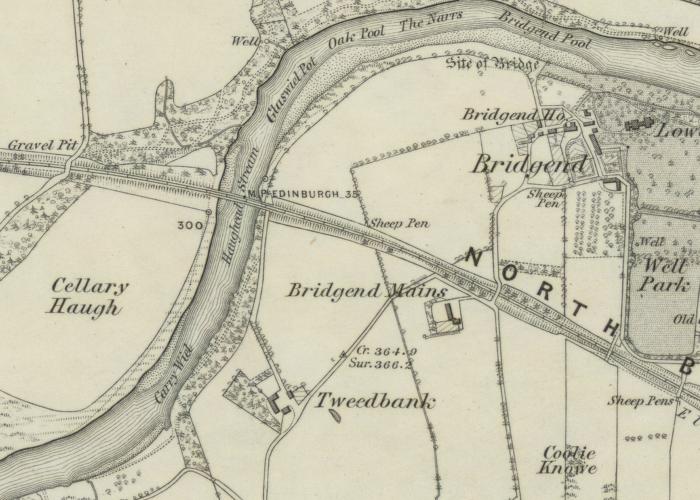
and follows the line of the second road for 2¾ miles to the northward, till crossing the Leader it enters Berwickshire. Half-a-mile SE of the mouth of the Leader, and 2½ miles E of the modern town of Melrose, is a promontory formed by a loop of the Tweed, and measuring 4 furlongs by 2, which is known as Old Melrose, and which is the 'projection' from which the name of the parish is said to come. The banks of the river all round are lofty, wooded, and rocky, and from them the ground rises in a smooth grassy ascent to a small plateau occupied by the modern mansion of Old Melrose. Old Melrose was the site of one of the earliest Columban establishments on the mainland of Scotland. It owed its foundation to St Aidan, who, with a number of brethren from Iona, had, about 635, on the invitation of Oswald, King of Northumbria, established a monastery at Lindisfarne (a island below Berwick and can only be crost at low tide) for the purpose of instructing the Saxons in Christianity. Aidan seems to have chosen twelve Saxon youths to be trained and sent out to preach and teach, and one of these, Eata, became, about the middle of the 7th century, the first abbot of the Columban monastery of Melrose. The prior during part of the time, and subsequently his successor, was that St Boisil or Boswell who has given name to the adjoining parish, and he in turn was succeeded by his pupil St Cuthbert. In the 9th century 839 the monastery was burned by Kenneth, King of Scots, but reappears again rebuilt, and the temporary restingplace of the body of St Cuthbert, which had been removed from Lindisfarne on account of the invasion of the Danes. It seems to have declined about the same time as the parent monastery in Iona, and to have become, in the latter part of the 11th century, ruined and deserted, for when between 1073 and 1075 Aldwin, Turgot-afterwards Bishop of St Andrews and confessor to St Margaret the queen of Malcolm III.-and other monks came from 'Girwy to what was formerly the monastery of Mailros' they found it 'then a solitude,'and they, being persecuted on account of their opinions and threatened with excommunication if they remained, had also soon to withdraw. From this time onward the place was never again the site of a monastery, but there was a chapel dedicated to St Cuthbert, and, till between 1126 and 1136, when David I. exchanged it for the church at Berwick, dependent on the priory of Durham, as the former church had been dependent on the abbey of Lindisfarne. This chapel seems to have been held in great esteem, for when it was burned by the English in the reign of Robert Bruce, in 1321, Symon, Bishop of Galloway, describing the chapel as recently burned by the English, grants 'a relaxation of forty days'penance to all truly penitent and confessed who should, with consent of their diocesan, devoutly visit the chapel of Saint Cuthbert of Old Melros, where that saint lived a monastic life and was celebrated for his miracles; or should contribute of theirmgoods'; while between 1417 and 1431 we find Pope Martin V., at the instance of John, dean of Cavertoun, one of the monks of Melrose, granting to all who should make pilgrimage to, or contribution to, the same chapel 'a remission of penance for seven years and seven Lents on all the festivals of St Cuthbert and on certain other holidays.' The place where the chapel stood continues to be called Chapelknowe, and adjacent portions of the Tweed still bear the names of Monk-ford and Haly-wheel-the holy whirlpool or eddy. Pilgrims from the north approached by a road known as the Girthgate, which led from Soutra hospice by Colmslie, near the centre of the northern portion of the parish and across the Tweed to the bend. It seems to have had the privilege of sanctuary. It crossed the river at Bridgend, about 1 mile W of Darnick, where a bridge with stone piers and wooden beams seems afterwards to have been built. Considerable remains of the latter are mentioned by Pennant in 1772 as having been standing when he visited the place. The early monastery seems to have been protected by a wall running across the neck of the peninsula, traces which remained in 1743, when Milne published his account of Melrose.
There are traditions of an abbey called the Red Abbey having stood near the village of Newstead, midway between Old and modern Melrose. In the district N of the Tweed there w ere chapels at Chieldhelles, at Blainslie on the extreme NE, and, according to Milne, also at Colmslie on Allan Water- said to take its name from the patron, St Columba- and at Gattonside. The present name of the parish seems to have been assumed from the old Culdee settlement, by the monks, when the modern abbey was founded, and applied by them to the whole district occupied by their early possessions, the boundaries of which correspond pretty nearly with the present limits of the parish. At the Reformation, and for a considerable time afterwards, down to about 1584, Melrose, Bowden, Lilliesleaf, and Langnewtoun were under the charge of one minister, with a reader at Melrose. In the year just mentioned it is noticed as a separate charge, and that state of matters continued. The earliest minister was John Knox, whose tombstone still remains in the abbey churchyard, and who was a nephew and namesake of the great Reformer. He died in 1623, and, under the modified Episcopacy of the time, was succeeded by Thomas Forrester, a poet, who was bold enough to introduce into the litany the special prayer, 'From all the knock-down race of Knoxes, good Lord, deliver us.` Besides this he also declared that the Reformation had done incalculable harm to Christianity; that the liturgy was better than sermon; and that bringing corn in from the fields on the Sabbath was a work of necessity-the last of which propositions he practically exemplified. For these and other delinquencies he was deposed by the Glasgow Assembly of 1638.
The principal antiquities, besides those already mentioned and those noticed in the following article, and in the account of the Eildon Hills, are remains of camps between Kittyfield and Leaderfoot; N of Kaeside, near Abbotsford; and at Mars Lee Wood; and border peels at Buckholm on the Gala, in the valley of the Allan, and at Darnick. The principal mansions, most of which are separately noticed, are Abbotsford, Allerly, Chiefswood-once the residence of Lockhart, Scott's sonin-law-Drygrange, Eildon Hall, Huntly-burn Houseonce the residence of Scott's friends, the Fergussons, and the name itself of Sir Walter's choosing - Gattonside House, Ladhope House, Langhaugh, Lowood, Abbey Park, The Pavilion, The Priory, Prior Wood formerly Prior Bankonce the residence of the well-known Edinburgh publisher, Tait, the founder of Tait's Magazine, which was established to oppose Blaekwood's Magazine-Ravenswood, Sunnyside, Threepwood,
Melrose, which is noticed in the following article, the parish contains also the villages of Blainslie (NE), Darnick (S), Gattonside (S), Newstead (SE), Newtown (extreme SE), and part of the town of Galashiels-all of which are separately noticed-and the hamlet of Eildon. Except in Galashiels there are no industries, and the
population of the parish are mostly engaged in agriculture. In suitable spots there are excellent orchards-legacies of the monkssome of which are very productive, those in the Gattonside district being said to produce more fruit than all the others in the vale of Tweed.
About ¾ mile WSW of the town of Melrose, on Bowden Moor, is the district lunatic asylum for the counties of Roxburgh, Selkirk, and Berwick, which with its grounds covers a space of 25 acres. The buildings occupy three sides of a rectangle; the
principal front to the SW being 377 feet long, and the wings each 148 feet. They are mostly two stories in height, and two towers are 100 feet high. The asylum was erected in 1870-72, after designs by Messrs Brown & Wardrop of Edinburgh, at a cost, inclusive of site, of £46, 500, and there is accommodation for about 150 patients.
To the N of Darnick, and about 1 mile W of the town of Melrose, is a rising-ground, called Skinners or Skirmish Hill, the name being taken from the last great battle among the borderers proper in 1526. In that year, James V., tired of the dominion of the Douglases, sent word, privately, to Scott of Buccleuch to come to his rescue. This Scott did, but the forces of Angus, Home, and the Kerrs proved too strong for him, and his men fled. Pitscottie tells the story at length. The place is now the site of the Waverley Hydropathic Establishment. Erected in 1871, and enlarged in 1876, this is a fine edifice, with accommodation for 150 visitors. Its dining and drawing rooms each are 84 feet long; and there are also a news-room, library, two billiard rooms, etc., besides every variety of bath. The grounds, 40 acres in extent, are tastefully laid out; and the view around is of singular beauty. In common with the whole district, the parish suffered severely from the ravages of the English during Hereford's invasions in 1544-45, and at a later date, Oliver Cromwell gets the credit of having pounded the ruins of the abbey from the heights above Gattonside. Besides the churches in the town, which are noticed in the following article, there are also Established and Free churches in Galashiels, on the Melrose side of the Gala (Ladhope), and thereis a U.P. church at Newtown. The civil parish contains the quoad sacra parish of Ladhope, which includes part of Galashiels. Ecclesiastically the parish is in the presbytery of Selkirk and the synod of Merse and Teviotdale, and the living is worth £482 a year. In 1883 the following were the schools-all public but the last-under Melrose school-board, with their accommodation, average attendance, and Government grant:-Blainslie (110, 64, £50, 17s.), Gattonside (87, 46, £37, 19s.), Glendinning Terrace (300, 342, £316, 13s.), Langshaw (51, 35, £40), Melrose (300, 177, £165, 0s. 6d.), and Newstead Subscription (86, 68, £46, 6s). Valuation (l864) £42, 344, 8s. 2d., (1882) £43, 757, 16s. 8d., (1884) £39,900, 12s. 5d. Pop. (1801) 2654, (l83l) 4339, (l861) 7654, (l87l) 9432, (l881) 11, 13l, of whom 4555 were in the ecclesiastical parish, and 6576 in Ladhope quoad sacra parish.- Ord. Sur., sh. 25, 1865. The U.P. Church has a presbytery of Melrose, which holds it meetings in the town, and includes 2 churches at Earlston, 3 at Galashiels, 3 at Hawick, 2 at Selkirk, and those at Innerleithen, Lauder, Lilliesleaf, Melrose, Newtown, and Stow. An accompanying 19th C. Ordnance Survey map is available. Note: This text has been made available using a process of scanning and optical character recognition.
Gazetteer for Scotland Help Glossary Map of Scottish Borders
Another website worth visiting is the Almanac of Galashiels and Selkirk dated 1898 1902. It lists everyone and every business in the towns, as this was pre television everybody had a job after work in their time off
https://archive.org/details/galashielsselkir1889dire/mode/2up
.
Gazetteer for Scotland Help Glossary Map of Scottish Borders Any Word People Places Statistics Member's Area Add Comment Melrose
A historical perspective, drawn from the Ordnance Gazetteer of Scotland: A Survey of Scottish Topography, Statistical, Biographical and Historical, edited by Francis H. Groome andoriginally published in parts by Thomas C. Jack, Grange Publishing
Works, Edinburgh between 1882 and 1885. This edition is copyright © The Editors of the Gazetteer for Scotland, 2002-2008.
Time Line
Roman BC to 450 at Trimontium, Saint Columba 521 to 557AD Saint Cuthbert 635 to 687AD Newstead Village the oldest Village in Scotland possible 10th Century Ledgerwood Chuch first record 1127AD but dates back to the 11th Century making it Scotlands oldest church, Briggend we think dates back to 1050 AD
Trimontium permision has been granted to start archaeological dig as this is the largest Roman site in Scotland dateing back to BC to 500Ad
St. Columba (born c. 521, Gartan [in County Donegal, Ireland]-died June 8/9, 597, Iona [Inner Hebrides, Scotland];
Sait Columba was the first person to bring Christianity the Scotland and would have been the main influance for others to follow, like Sait Cuthbert born 635 - 687 only about 55 years built a Chapel at Old Melrose along with some of Columba followers.
Half a mile from Trimontium lies Newstead the oldest continuous inhabited village in Scotland it also has 4 Abbys, Melrose, Dryburgh, Jedburgh and Kelso, dating 1132 all within 20 miles.
The knight's templar began in the early 12th century during the height of the crusades. Founded to protect Christian pilgrims traveling to the holy land. It is said they were Free Masons, after most were killed in France they went underground and eventually fled to Scotland mid 1300s I think I can tie that in as the Free Mason Lodge number 1 is halfway down Melrose high st on the right hand site.
We Still have Templers today who are free masons.
Sir Walter Scott
Was a huge figure in the Melrose area his House Abbottford 1 mile away is steeped in history and has very good visitor center
What you are reading is the oldest History on Scotlands main land BC to 2019, 2019 years of history to explore.
You will read about the Duke of Roxburgh of Floors Castle who had a castle at Cessford near Morebattle, and the Duke of Bucclugh, these two houses were gifted all the land between Berwick on the east coust went to the Duke of Roxburgh and to the west located at the Solway Firth, where the border with England meets the sea were given to the Duke of Bucclugh this makes them the richest land owners in the UK. These were gifted by the crown for services to the crown for signing over their Scottish armies to the crown. The Scottish Borders is not regarded in Scotland as part of Scotland.
The Borders were so wealthy there was 2,400 houses who employed servants.
The local newspaper the Southern Reporter was the main financial news papers in Britain hundreds of years ago and is still published today.
The Knights Templar
THe Story of the knight's templar begins in the early 12th century during the height of the crusades. Founded to protect Christian pilgrims traveling to the holy land the Templar's quickly Rose to power becoming a military Force a religious order and the world's first multinational bank but with power came secrets whispers began to emerge that the Templars had discovered something extraordinary beneath the Temple of Solomon in Jerusalem something not meant for the eyes of Ordinary Men some say it was the Holy Grail others claim it was ancient texts even Relics from a Civilization lost to time but all legends agree the Templars had knowledge that could challenge the authority of kings and even the Pope they became untouchable their castles dotted Europe their wealth rivaled monarchs and their influence crept into Every Corner of Medieval Society but power breeds enemies in 1307 on Friday the 13th King Philip the fourth of France deep in debt to the Templars ordered their sudden arrest under torture many confess to heresy Idol worship and secret rituals some said they worship to mysterious head called baffomet other they spot on the cross denied Christ and practice rights in the Dark Truth or a political smear campaign to destroy a threat the last grandmasters burned at the stake in 1314 with his final breath he cursed the Pope in The King and both were dead within a year the Templars officially were no more but their knowledge that didn't burn with them Legends say that templers didn't die they went underground some believe they became sacred knowledge into a new age others claim they fled to Scotland bringing Free Masonery with them.
Free Masons say the Knights Templar brought Free Masonery to Scotland, and they say the first lodge is 0 and is in Edinburgh. Below you will see lodge number 1 plus a small 2 after it. Free Masons believe lodge 1 was in Mussleburgh and this was lodge 1 plus 2 in Melrose, it can be seen half way down Melrose high street on the right.
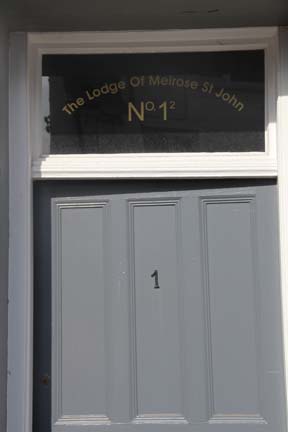
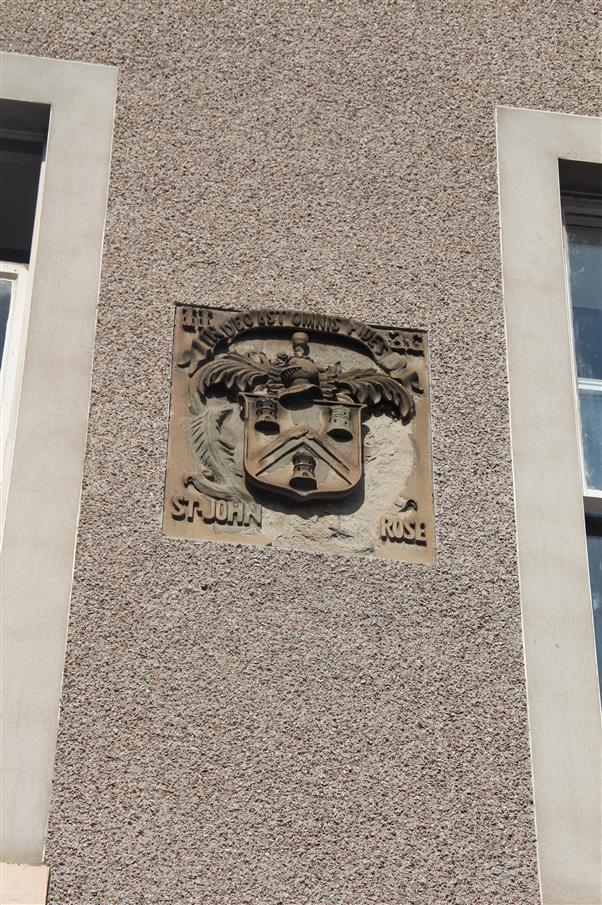
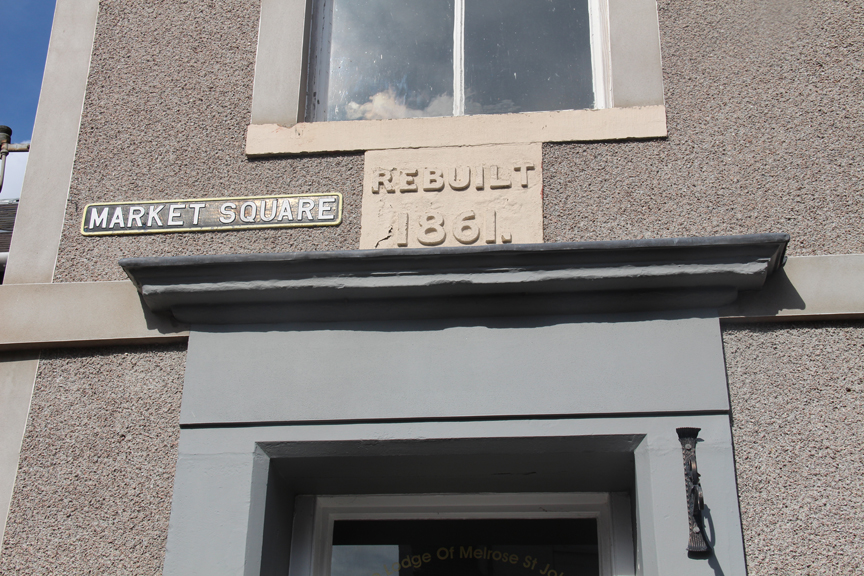
To the N of the Tweed the ground again rises rapidly to an elevation of over 700 feet, and then passes northwards in two ranges of heights, of which that to the E, between the valleys of the Leader and Allan, is 876 feet high near Avenel plantation, 929 between Housebyres and Mosshouses, 979 near Jeanfield, 829 near the border W of Blainslie, and 1057 farther to the W between Newhouses and Threepwood; that to the W, between the valleys of the Allan and Gala, is 1018 feet (S) and 1031 (N) at Langlee, 1064 at Buckholm Hill, 1315 at William Law, 1219 at Hawkshawhead, and 1126 at Allanshaws. The lower districts are cultivated, and the upper afford excellent pasture, while plantations and belting of trees are to be found all over the parish, and cover about 3000 acres. The soil in the southern district is chiefly a strong clay, well adapted for wheat. Along the valley of the Tweed-where there seems to have been at one time a great lake, and where, even within the last two centuries, the river course has evidently in places been changed; since a fine rich haugh, now on the S side of the river, is called Gattonside Haugh, and its feudal tenures show that it once actually formed a part of the Gattonside lands, which are on the N side of the river-it is a rich alluvial earth; while the northern district varies from light loam mixed with sand on a gravelly bottom, to strong wet clay full of springs, and moss which sometimes overlies marl.
The underlying rocks are Lower Silurian, above which, in the S and SE are sandstones of later age. These are quarried for building purposes, but the rock is of inferior quality, and most of the building-stone used is brought from adjoining parishes. The drainage of the parish is effected on the W by the Gala and the burns flowing into it, of which the Halk Burn is the chief; in the centre by Allan Water, which, rising at the NW corner at Blinkbonnie, flows southward for 9 miles to the Tweed, a short distance above Pavilion, 1½ mile above Melrose. It receives a number of smaller burns, of which the chief is Threepwood Burn. The lower part of its course is prettily wooded, athe prototype of the 'Glendearg' of Sir Walter Scott's Monastery. Thend the valley is drainage on the E is carried off by the Leader and the various burns entering it, of which the Clackmae and Packmans Burns are the chief. In the portion of the parish to the S of the Tweed are Huntly Burn, entering the Tweed opposite Gattonside; Malthouse or Dingle Burn, flowing past the town of Melrose; Bogle Burn, rising on the SE side of the Eildon Hills, and entering the Tweed at Old Melrose; a burn joining the Tweed near Langlands; and the lower part of the course of Bowden Burn. Huntly Burn is closely associated with Thomas the Rhymer (see Earlston), and one finely-wooded hollow on its course-a favourite resort of Sir Walter Scott-is known as The Rhymer's Glen. Bogle Burn also is said to take its name from the Bogles or Goblins with whom Thomas was so familiar. The parish is traversed by the main inland road from Edinburgh to Berwick, which winds along the N side of the Gala, crosses the Tweed by a good stone bridge W of Darnlee, passes through the town of Melrose, and then south-eastward by Newtown till it joins the road from Selkirk to Kelso, and thence to Berwick. From N to S, on the E border, along the valley of the Leader, is a main road, leaving the south coastroad at Musselburgh, traversing Lauderdale, crossing the Tweed close to the mouth of the Leader, and joining the first main road ¾ mile N of Newtown.
The main section of the North British railway, worked in connection with the Midland railway, and known as the Waverley route, passes through the parish, keeping closely to the line of the first-mentioned main road; while 2 miles beyond Melrose station it is joined by the Berwick and Duns branch of the same system, which crosses the Tweed at Leaderfoot,